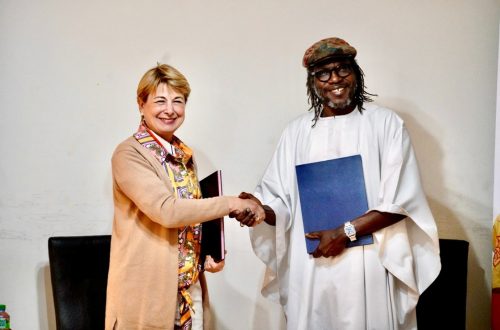
On 14 and 15 May 2026, the West Africa Network for the Protection of Children (WAN/RAO) held its 21st Annual Meeting in Lomé, Togo, together with its Annual Peer Review. Over two days, fourteen countries reflected together on the future of protection for children and young people on the move, in a fast-changing regional context.
Organised by International Social Service – West Africa (ISS-WA/SSI-AO) with the support of the Swiss Agency for Development and Cooperation, this edition was held under the theme “WAN facing new challenges and opportunities: strengthening transnational protection for children and young people in situations of vulnerability”. It brought together the network’s national coordinations, State child-protection bodies, civil-society organisations and technical and financial partners from Benin, Burkina Faso, Côte d’Ivoire, The Gambia, Ghana, Guinea, Guinea-Bissau, Liberia, Mali, Niger, Nigeria, Senegal, Sierra Leone and Togo.
The opening ceremony was chaired by the Togolese Minister responsible for social action, solidarity and child protection, who praised WAN’s strategic role in regional cooperation and child protection across West Africa.
Child protection as an investment in human development
In the inaugural lecture, Dr Fall, Director of ISS-WA, invited participants to see child protection differently — not as a mere humanitarian response, but as a genuine investment in human development, social cohesion and the stability of West African societies. Vulnerabilities linked to mobility, migration, trafficking or family separation cannot be addressed at the national level alone: they call for regional cooperation mechanisms able to ensure continuity of protection across borders. In this respect, he recalled, WAN is an innovative response grounded in regional solidarity and collective responsibility towards the most vulnerable children.
Panels rooted in field realities
Four thematic panels shaped the discussions. The first, on child marriage in contexts of crisis and mobility, underlined how exposed girls are, and called for this risk to be systematically integrated into case management and for stronger advocacy with States. The second addressed the restructuring of economic and humanitarian partnerships: faced with shifting funding and aid-localisation requirements, participants saw an opportunity to strengthen local actors’ leadership and diversify resources. The third focused on security challenges, reaffirming the central role of community-based protection mechanisms in hard-to-reach areas. The fourth examined political changes and new regional frameworks — including the Alliance of Sahel States — stressing the need to preserve the gains of cross-border cooperation.
Strengthened governance
The meeting marked a decisive step with the roll-out of the governance framework set out in the 2021–2030 Strategic Plan, built around the Strategic Orientation Committee (SOC), the Expertise Group and the national networks. Meeting as the SOC, the member States’ Directors of Child Protection unanimously elected the Director of Child Protection of Benin to chair the Committee for a one-year term — a step that reinforces the network’s legitimacy and sustainability.
MigrAO, a new digital tool for protection
A highlight of the meeting, the MigrAO (migrao.net) platform was officially launched on 15 May 2026. Designed as a tool for connection, coordination and information management, it links practitioners, organisations and young people across West and North Africa. It offers instant chat, a forum, private messaging, a resource library and a news feed, and integrates an online protection training course (via ChildHub, developed by Terre des hommes) as well as an interactive map of more than one hundred field services. Evolving by design, the platform will continue to be enriched based on needs and user feedback.
Three strategic priorities for 2026–2028
Les travaux ont débouché sur trois axes structurants :
- Coordination régionale, positionnement institutionnel et mobilisation des ressources ;
- Adaptation des approches de protection et continuité des interventions dans les zones affectées par l’insécurité ;
- Harmonisation des outils, coopération transfrontalière et meilleure gestion des données de protection.
Au-delà des orientations techniques, la 21ᵉ Réunion annuelle a réaffirmé la force du RAO comme espace régional de dialogue, de solidarité et d’action collective. Dans un contexte marqué par de profondes mutations, ses membres ont renouvelé leur engagement à préserver la continuité de la protection des enfants et des jeunes au-delà des frontières — au service de l’intérêt supérieur de chaque enfant.
Three strategic priorities for 2026–2028
The proceedings produced three structuring priorities:
- Regional coordination, institutional positioning and resource mobilisation;
- Adapting protection approaches and ensuring continuity of interventions in areas affected by insecurity;
- Harmonising tools, cross-border cooperation and better protection-data management.
Beyond the technical orientations, the 21st Annual Meeting reaffirmed WAN’s strength as a regional space for dialogue, solidarity and collective action. In a context of profound change, its members renewed their commitment to preserving continuity of protection for children and young people across borders — in the best interests of every child.